
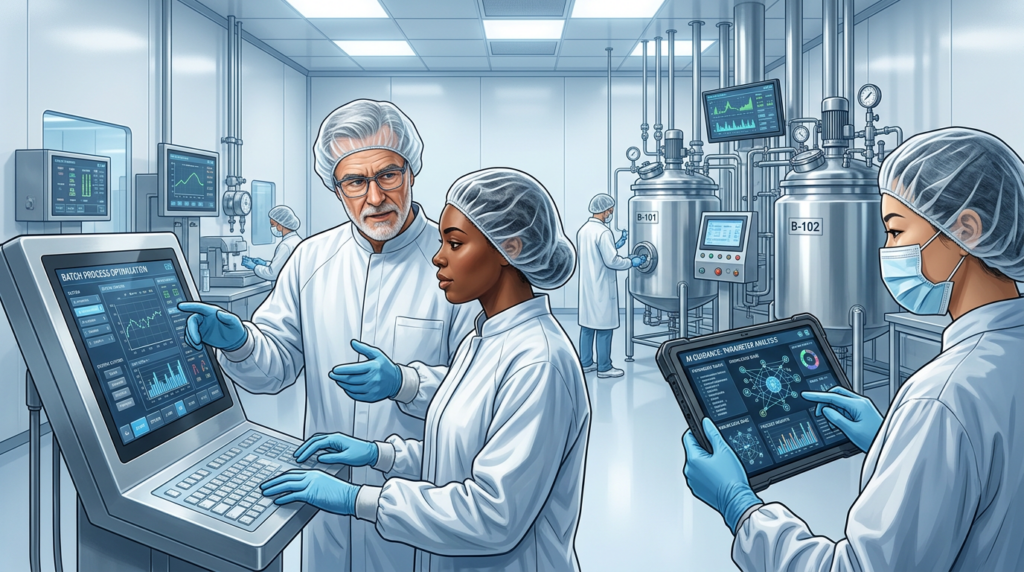
The pharmaceutical manufacturing sector stands at a critical crossroads. As Baby Boomers, who make up a substantial portion of the skilled manufacturing workforce, approach retirement, the industry faces an urgent need to preserve decades of accumulated knowledge while preparing a new generation of workers to take their place. This generational shift threatens not just staffing levels, but also the continuity of specialized expertise that ensures quality, compliance, and innovation across the industry.
As experienced engineers, operators, and validation specialists retire, many sites face a dual risk: losing deep tacit process knowledge and lacking enough trained successors to manage complex, highly regulated facilities. This is especially acute in areas like commissioning, qualification, validation (CQV), and digital manufacturing systems, where expertise is built over decades of projects and inspections.
The Scale of the Talent Shortage
This challenge is no longer theoretical, it is showing up clearly in the data. One recent analysis of the U.S. pharma and life sciences market projects that the sector will face a persistent 35% talent deficit by 2030 if current trends continue. In parallel, UK workforce projections estimate that life sciences employers will need around 133,000 additional skilled scientific staff by 2030 to meet growth and replace retirees, including about 43,000 roles in biopharma and 6,400 specifically in biopharma manufacturing.
More broadly, manufacturers across industries are already struggling to fill critical roles, with forecasts suggesting that millions of manufacturing positions could remain unfilled over the next decade without new strategies to attract, train, and retain talent. For pharmaceutical manufacturers operating in a highly regulated, quality driven environment, this structural shortage amplifies the risk of a steep knowledge cliff as Boomers retire.
The Knowledge Cliff: What’s at Stake
Boomers entered pharmaceutical manufacturing in an era defined by strict regulatory evolution, manual processes, and continuous optimization. Many of these employees now possess deeply ingrained, experience-based knowledge that is rarely written down. From nuanced troubleshooting of complex equipment to the tacit understanding of regulatory intricacies, much of what they know cannot be easily captured in standard operating procedures or digital manuals.
As these employees retire, companies risk a “knowledge cliff”, a sudden loss of expertise that can slow production, increase compliance risk, and hinder operational excellence. In highly regulated environments where quality cannot be compromised, this loss is especially perilous.
AI as a Knowledge Transfer Multiplier
Artificial intelligence is emerging as a powerful tool to capture, structure, and scale the expertise of retiring workers. Rather than relying solely on manual documentation or one-to-one mentorship, AI can transform how knowledge is preserved and accessed across the enterprise.
Organizations are beginning to use AI to:
- Capture tacit knowledge at scale by analyzing historical batch records, deviation reports, commissioning documentation, and operator logs to identify patterns in decision-making and troubleshooting.
- Create intelligent knowledge assistants that allow new employees to query systems in natural language, retrieving context-specific guidance drawn from validated procedures, past projects, and site-specific practices.
- Convert unstructured knowledge into structured training content by turning video recordings, SME interviews, and workshop outputs into searchable, role-based learning modules.
- Enhance SOPs and work instructions with embedded AI guidance that provides real-time recommendations, risk alerts, and decision support during execution.
- Enable continuous learning loops where AI systems learn from new deviations, investigations, and process improvements, ensuring knowledge bases evolve rather than becoming static repositories.
In this way, AI does not replace experienced workers—it extends their impact, allowing their expertise to guide future generations long after retirement.
Bridging Generations Through Knowledge Transfer
To combat the exodus of experience, the focus must shift to deliberate knowledge transfer. This requires more than mentorship programs or casual shadowing. Leading organizations are institutionalizing the process through structured strategies such as:
- Formal mentorship programs that pair senior experts with high-potential employees, ensuring systematic skill transmission.
- Knowledge capture workshops that record best practices, troubleshooting insights, and decision-making rationales before retirement.
- Cross-functional rotations to expose younger employees to multiple stages of production, enhancing system-level understanding.
- Digital knowledge repositories that use video documentation, AR/VR scenarios, and searchable databases to preserve and share tacit knowledge.
When combined with AI, these tools become significantly more powerful, transforming static repositories into dynamic systems that guide users, surface insights, and reinforce learning in real time.
Hands on training as a knowledge transfer engine
Even with strong documentation, high stakes skills are best transferred in realistic environments where teams can practice without risking production or compliance failures. Sequence’s focus on developing its own engineering consultants through structured training, mentoring, and job shadowing illustrates how intentional, hands on learning can rapidly build competency that once took veterans years to acquire on the job.
For manufacturers, similar training models can:
- Accelerate new hire readiness through blended approaches that combine classroom instruction, shadowing, and supervised practice on real or mock systems.
- Give experienced staff tools and frameworks to mentor successors more effectively in a structured, consistent way rather than ad hoc coaching.
- When augmented with AI-driven simulation and feedback, these environments can adapt to individual learners, highlight skill gaps, and replicate rare or high-risk scenarios that may not occur frequently in live production.
Training the Next Generation Workforce
While knowledge transfer addresses the short-term gap, long-term resilience lies in robust training pipelines. Modern training must blend technical instruction with soft skills like problem-solving and regulatory reasoning. Some effective approaches include:
- Apprenticeships and partnerships with community colleges to create clear entry paths for technicians and engineers.
- Simulation-based training to safely teach complex manufacturing processes using digital twins and VR environments.
- Modular e-learning systems that accelerate onboarding and allow flexible, continuous skill development.
- Upskilling programs that help current employees adapt to new automation technologies while retaining human oversight.
- AI enhances these approaches by personalizing learning paths, recommending targeted content based on performance, and providing real-time coaching during both training and on-the-job execution.
Digital SOPs and structured curricula
As Boomer experts retire, much of their value lies in the “why” behind each step of a procedure and the subtle decision rules used on the floor. By collaborating with engineering consulting partners like Sequence to formalize and digitize SOPs, work instructions, and training curricula — including embedded media, decision points, and clear acceptance criteria — manufacturers can turn paper based, person dependent processes into structured, teachable content that scales across sites and shifts.
Layering AI onto these digital systems allows companies to:
- Embed expert decision-making logic directly into workflows, guiding operators through complex scenarios with contextual recommendations.
- Identify trends in user errors or deviations and proactively adjust training or procedures.
- Continuously refine SOPs based on real-world execution data, ensuring procedures reflect current best practices rather than outdated assumptions.
A Strategic Imperative, Not a Temporary Fix
The coming wave of retirements is not a distant concern, it’s already unfolding. Pharmaceutical manufacturers that act now to institutionalize knowledge management, AI-enabled insights, and continuous learning will sustain operational excellence and regulatory compliance through this transition. Those that do not risk falling behind in an industry where precision and quality are non-negotiable.
Closing the retirement gap is not just about backfilling roles, it is about creating a resilient capability engine that continually develops and redeploys expertise. By combining engineering consulting, structured knowledge capture, AI-driven insights, and robust training programs, Sequence helps manufacturers design facilities and processes that are easier to learn, operate, and maintain across generations, ensuring that critical know how is embedded in systems and people, not just in the memories of a shrinking cohort of Boomers.
Find out more about Sequence Engineering Consulting Services and Operational Readiness Training in our mock pharmaceutical manufacturing training facility.
How can Sequence support your project needs?
Find out more at Info@SequenceQCS.com