
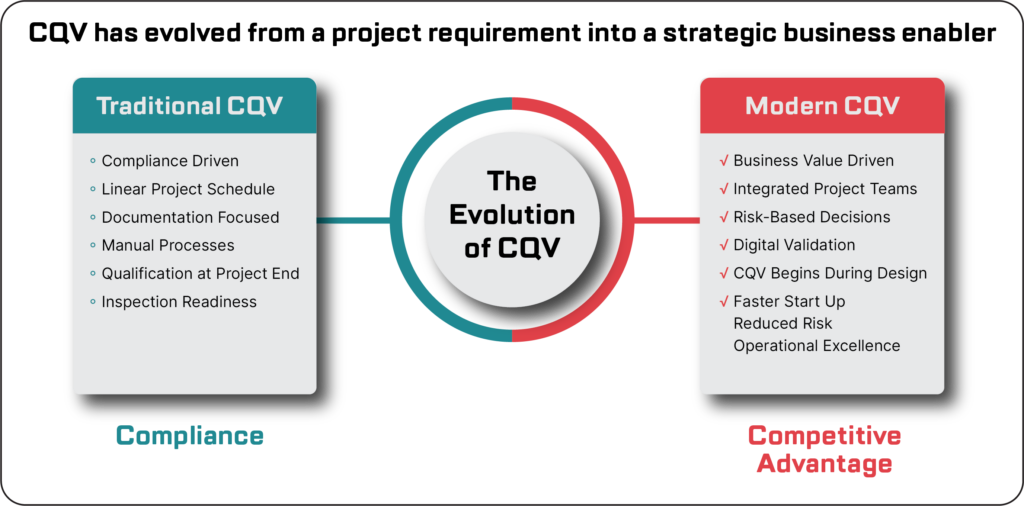
For decades, Commissioning, Qualification, and Validation (CQV) has been viewed primarily as a regulatory obligation, a necessary step to demonstrate that facilities, utilities, equipment, and computerized systems meet FDA and global regulatory expectations before manufacturing can begin.
While regulatory compliance remains the foundation of every successful CQV program, the role of CQV has evolved significantly. Leading pharmaceutical, biotechnology, cell and gene therapy, and advanced manufacturing organizations now recognize that an effective CQV strategy can deliver far more than inspection readiness. When integrated early into project planning and executed with a risk-based methodology, CQV becomes a powerful driver of schedule acceleration, operational efficiency, product quality, and long-term business performance.
At Sequence, LLC, we have seen this transformation firsthand across greenfield facilities, manufacturing expansions, technology transfers, and digital transformation initiatives. To achieve the greatest success, we’re no longer asking, “How do we pass validation?” Instead, we’re asking, “How do we use CQV to accelerate our client’s business?”
CQV Has Changed, And So Have Industry Expectations
The pharmaceutical manufacturing landscape has changed dramatically over the past decade.
Manufacturing technologies are becoming increasingly automated and data-driven. Modular facilities are reducing construction timelines. Personalized medicines and advanced therapies require greater manufacturing flexibility. At the same time, organizations face increasing pressure to reduce time-to-market while maintaining the highest standards of quality and patient safety.
Traditional CQV approaches, often characterized by extensive documentation, sequential project execution, and manual testing, can become significant schedule constraints when applied without modernization.
Today’s successful projects require CQV to be fully integrated with engineering, automation, quality, manufacturing, and project management from the earliest stages of facility design.
Rather than serving as the final checkpoint before production, the best CQV strategies now function as an enabling discipline throughout the project lifecycle.
Risk-Based Validation Drives Better Business Outcomes
Modern regulatory guidance has shifted away from exhaustive testing toward scientifically justified, risk-based approaches.
Rather than validating every possible function with equal rigor, organizations are encouraged to focus effort where patient safety, product quality, and data integrity are most at risk. This philosophy aligns with guidance such as ASTM E2500, FDA Process Validation, and ICH Q9 Quality Risk Management.
The benefits extend well beyond regulatory compliance. Based on Sequence’s experience delivering CQV programs across the life sciences industry, organizations that successfully implement a risk-based approach often realize measurable improvements in both project execution and operational performance.
A well-executed risk-based CQV program can:
- Reduce unnecessary testing and documentation by eliminating low-value qualification activities and concentrating verification efforts on functions that have a direct impact on product quality and patient safety.
- Accelerate qualification activities through streamlined testing strategies, enabling facilities and manufacturing systems to achieve operational readiness and commercial production more quickly.
- Improve engineering efficiency by allowing multidisciplinary teams to prioritize their time on higher-risk systems, resolve critical issues earlier, and reduce rework throughout the project lifecycle.
- Reduce project costs by minimizing redundant testing, optimizing resource utilization, and shortening overall CQV schedules without compromising compliance or quality.
- Focus quality resources on critical systems so quality and validation teams can dedicate greater attention to high-risk equipment, processes, and controls that require the most rigorous oversight.
- Increase confidence during regulatory inspections by providing a well-documented, scientifically justified validation strategy that clearly demonstrates a risk-based rationale aligned with current regulatory expectations.
This approach shifts CQV from a documentation-heavy compliance exercise to a strategic quality assurance process that delivers faster project execution, more efficient resource utilization, and greater long-term operational value.
Integrating CQV Earlier Accelerates Project Delivery
One of the most significant shifts in modern capital projects is the integration of CQV activities during design and construction rather than after equipment installation.
Historically, qualification often began once engineering activities were substantially complete. This sequential approach frequently resulted in late-stage design changes, documentation revisions, delayed startup, and schedule compression.
Today, successful organizations implement commissioning-led CQV strategies that integrate quality and validation activities throughout the project lifecycle. Based on Sequence’s experience supporting complex pharmaceutical and biotechnology facilities, this proactive approach enables project teams to identify and resolve issues earlier, when they are less costly and easier to address.
Key elements of a successful commissioning-led CQV strategy include:
- Design reviews that evaluate systems against user requirements, regulatory expectations, and quality risk assessments before construction begins, helping prevent downstream design deficiencies.
- Commissioning planning that establishes a structured roadmap for system turnover, testing, and qualification, ensuring engineering and CQV activities are coordinated from project inception.
- Requirements traceability that links User Requirements Specifications (URS) through design, commissioning, testing, and qualification, providing clear evidence that critical requirements have been verified.
- Vendor documentation review to assess design packages, material certifications, calibration records, software documentation, and test results early, reducing documentation gaps and minimizing qualification delays.
- Factory Acceptance Test (FAT) support that incorporates validation objectives into factory testing, allowing defects, configuration issues, and performance concerns to be identified and corrected before equipment reaches the site.
- Site Acceptance Test (SAT) integration that builds upon FAT results by verifying proper installation, integration, and operational performance within the manufacturing environment, reducing redundant testing during qualification.
- Early quality involvement that embeds Quality Assurance and validation stakeholders throughout the project lifecycle, enabling timely risk assessments, faster decision-making, and stronger alignment with regulatory expectations.
By identifying technical and quality issues earlier, project teams significantly reduce costly rework while creating a more efficient transition from construction and commissioning into qualification and commercial manufacturing. At Sequence, we support our clients by deploying a commissioning-led CQV strategy designed to consistently achieve greater schedule predictability, improve cross-functional collaboration, leading to a faster path to manufacturing readiness without compromising compliance or product quality.
Digital Validation Is Transforming Project Execution
Digital transformation is reshaping nearly every aspect of pharmaceutical manufacturing, and CQV is no exception.
As facilities become more connected and project complexity continues to increase, organizations are adopting digital validation lifecycle management tools, automated test execution platforms, digital turnover packages, and integrated data management systems to improve both project execution and long-term operational performance. It’s more clear than ever that delivering CQV programs for global pharmaceutical, biotechnology, and advanced manufacturing clients, digital technologies are no longer simply replacing paper, they are fundamentally changing how qualification activities are planned, executed, reviewed, and managed.
These technologies provide significant advantages across the CQV lifecycle, including:
- Improved documentation accuracy through standardized digital workflows, controlled templates, and automated data capture that reduce manual entry errors, improve consistency, and strengthen data integrity.
- Greater review cycle efficiency by enabling electronic workflows, parallel document reviews, automated routing, and digital approvals, significantly reducing document turnaround times and accelerating project schedules.
- Enhanced traceability by maintaining clear digital links between user requirements, design specifications, commissioning activities, test protocols, deviations, and final qualification records, providing complete lifecycle visibility.
- Stronger audit readiness through centralized, version-controlled documentation and secure electronic records that allow project teams to quickly retrieve evidence, demonstrate compliance, and respond confidently during regulatory inspections.
- Improved collaboration across global project teams by providing real-time access to qualification documentation, project dashboards, issue tracking, and testing results regardless of geographic location, enabling engineering, quality, vendors, and project stakeholders to work from a single source of truth.
Beyond improving individual processes, digital CQV provides leadership with real-time visibility into project execution. Interactive dashboards, automated reporting, and live qualification metrics allow teams to monitor system readiness, identify schedule risks, track critical path activities, and proactively address issues before they impact project milestones.
From Sequence’s perspective, the greatest value of digital CQV extends beyond eliminating paper documentation. When thoughtfully implemented, digital solutions create a connected validation ecosystem that improves decision-making, enhances data quality, reduces project risk, and supports faster, more predictable facility startup. As the industry continues to embrace digital manufacturing and Pharma 4.0 initiatives, organizations that modernize their CQV practices will be better positioned to deliver compliant facilities with greater efficiency, transparency, and operational resilience.
CQV Is Becoming a Strategic Business Function
Perhaps the greatest evolution in CQV is organizational.
Rather than existing solely within Quality or Validation departments, CQV increasingly serves as a bridge between engineering, operations, automation, manufacturing science, quality assurance, and executive leadership. When delivering complex capital projects across the life sciences industry, the most successful organizations treat CQV as an integrated business function that aligns technical execution with broader operational and commercial objectives.
Successful CQV organizations contribute directly to key business objectives such as:
- Faster facility startup by integrating commissioning, qualification, and validation activities early in the project lifecycle, reducing delays and accelerating operational readiness.
- Reduced capital project risk through proactive risk identification, disciplined planning, and cross-functional coordination that minimize costly rework, schedule impacts, and technical uncertainties.
- Earlier commercial manufacturing by streamlining the transition from construction to qualified operations, enabling facilities to begin producing compliant product sooner and achieve revenue-generating milestones more quickly.
- Improved asset reliability by verifying that equipment, utilities, automation systems, and manufacturing processes consistently perform as intended from initial startup through routine operations.
- Operational excellence through standardized CQV methodologies, data-driven decision-making, and continuous collaboration that improve project execution while establishing a strong operational foundation for long-term manufacturing performance.
- Reduced lifecycle costs by identifying design and performance issues early, optimizing maintenance and qualification strategies, and minimizing future operational disruptions, investigations, and change management efforts.
These outcomes directly influence revenue generation, manufacturing capacity, and competitive positioning. In today’s environment, every week gained during facility startup can represent millions of dollars in additional product availability and market opportunity.
The Sequence Approach to CQV
At Sequence, LLC we believe CQV should do more than satisfy regulatory requirements, it should create measurable business value.
Our multidisciplinary teams integrate commissioning, qualification, validation, engineering, automation, quality, and project delivery expertise to support clients throughout the entire facility lifecycle.
Whether supporting a new biologics manufacturing facility, semiconductor manufacturing infrastructure, pharmaceutical expansion, or technology transfer, our focus remains consistent:
- Build quality into the project from day one.
- Reduce execution risk through proactive planning.
- Apply science- and risk-based methodologies.
- Accelerate startup without compromising compliance.
- Deliver sustainable operational readiness.
By combining technical expertise with practical project execution experience, we help organizations transform CQV from a project milestone into a strategic advantage.
Looking Ahead to the Future of CQV
As pharmaceutical manufacturing continues to evolve, CQV will become even more integrated with digital technologies, advanced automation, artificial intelligence, and data-driven manufacturing strategies.
Organizations that continue to view CQV solely as a compliance activity risk longer project schedules, higher costs, and missed opportunities for operational improvement.
Those that embrace CQV as a strategic business function will be better positioned to accelerate innovation, improve manufacturing performance, and bring life-changing therapies to patients faster.
The future of CQV is no longer defined by documentation alone, it is defined by its ability to enable smarter projects, faster startup, and stronger business outcomes.