
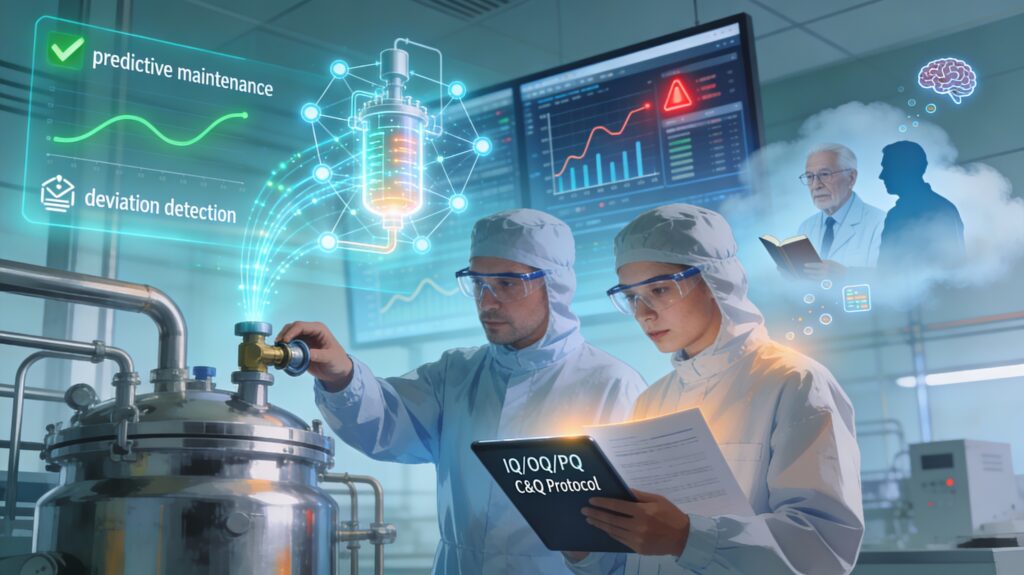
Artificial intelligence is transforming pharmaceutical engineering at every level of manufacturing. From advanced process control and predictive maintenance to deviation detection and real-time release testing, AI-driven systems are accelerating decision-making and operational efficiency. However, as technology assumes a more active role in process evaluation and execution, the question arises: what happens to the deep institutional knowledge and human judgment that have long underpinned pharmaceutical quality, compliance, and operational excellence?
The Erosion Risk: Losing Tacit Knowledge
Institutional knowledge in pharma is built on decades of tacit understanding, how minor process fluctuations affect product yield, how raw material variability manifests downstream, or how equipment behaviors shift over time. These insights are not always captured in SOPs or training matrices; they live within specialists who have learned through repeated exposure and iterative problem-solving.
When AI systems automate parameter tuning or anomaly detection, new engineers risk losing that “felt experience” of the manufacturing environment. Over time, tacit knowledge erodes, leaving fewer engineers who can interpret why deviations occur or how to adjust processes within the boundaries of good manufacturing practice (GMP). In a sector where documentation alone never tells the full story, the loss of experienced judgment creates measurable risk, not only for efficiency and yield but also for patient safety and regulatory compliance.
Why Institutional Knowledge and Critical Thinking Matter in C&Q
The impact of this erosion becomes especially pronounced during commissioning and qualification (C&Q) of new facilities, utilities, and equipment. C&Q is not simply a checklist exercise. It is a rigorous process that validates design intent, confirms process capability, and demonstrates control within regulatory expectations.
In these stages, institutional knowledge (the accumulated understanding of equipment performance, process interdependencies, and system behaviors) is crucial. Engineers drawing upon this expertise can predict integration challenges, anticipate points of failure, and design testing strategies that verify true operational readiness, not just paperwork compliance.
Critical thinking is equally vital. C&Q professionals must evaluate data streams, interpret unexpected results, and make real-time decisions that affect validation outcomes. They need to identify when an out-of-spec result signals a true design deficiency versus a data artifact. AI tools can streamline documentation or flag anomalies, but they cannot replace the nuanced judgment required to determine whether a system genuinely meets user requirements or if a test methodology compromises data integrity.
AI’s Influence on Critical Thinking and Process Understanding
Without engineers grounded in both experiential knowledge and analytical reasoning, organizations risk producing facilities that are qualified on paper but fragile in performance.
AI’s growing role introduces a paradox: while it provides richer datasets for analysis, it can also distance engineers from the direct process insights that feed sound judgment. If professionals rely too heavily on AI-generated conclusions during C&Q, such as automated trend detection or predictive validation, critical thinking skills may erode. Engineers could start trusting the output over their own scrutiny, losing sight of the process context that explains why an event occurs.
For true operational excellence, C&Q professionals must integrate digital acumen with system-level reasoning, risk management, and a thorough understanding of how design controls tie back to product quality attributes.
Reinforcing Expertise Through Hands-On Training
Hands-on, experiential learning remains essential to preserving this depth of understanding. Direct engagement with systems, whether performing startup testing, calibrating equipment, or analyzing deviations during performance qualification, builds an awareness of how theory translates to reality. It sharpens engineers’ ability to connect design intent to operational execution, ensuring that critical thinking remains central throughout validation and site startup.
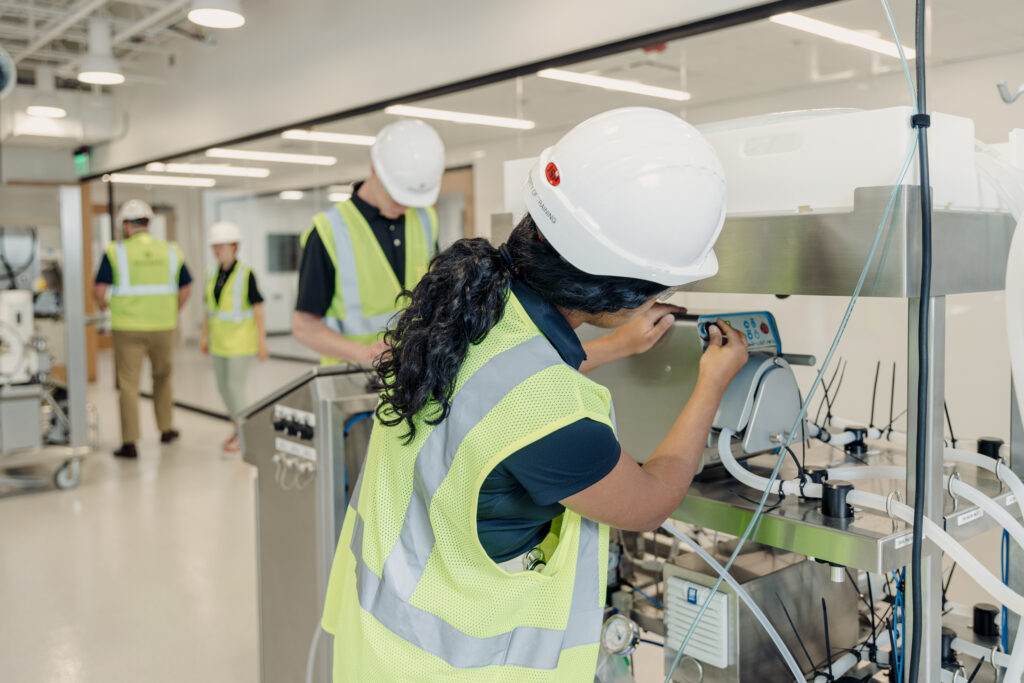
Sequence’s hands-on training programs are successfully bridging this gap. By combining immersive, GMP-aligned instruction with real-world process scenarios, we equip our engineering consultants with the understanding of not only how to execute a protocol but also why each step matters. Our approach integrates human performance development with technical upskilling, allowing our team to make informed decisions during commissioning, equipment qualification, and technology transfer.
Sequence’s experiential model enhances both process and compliance acumen. Our engineers practice documentation discipline, risk-based investigation, and system troubleshooting in simulated production environments, skills that directly translate to more robust and efficient C&Q activities. This ensures that while AI and automation continue to streamline workflows, the human understanding of process control and validation integrity remains intact.
AI as an Accelerator, Not a Crutch
AI’s highest value emerges when it complements, rather than substitutes, human expertise. When paired with robust experiential training frameworks, AI tools can strengthen C&Q execution by enhancing data transparency, supporting real-time monitoring, and improving documentation accuracy.
Digital twins and predictive models can simulate process conditions before startup, allowing engineers to anticipate design challenges before they occur. However, only a workforce skilled in both hands-on practice and analytical review can interpret and apply these insights responsibly. Sequence’s blended approach ensures that our consulting engineers see AI outputs as supportive evidence—never as unquestioned truth.
Building a Resilient, Hybrid Workforce
Pharmaceutical manufacturers are entering a new era of hybrid expertise: one that values both digital fluency and deep process literacy. The organizations best positioned for sustainable success are those embedding AI within human development strategies—training engineers to leverage intelligent tools without relinquishing control of understanding.
By partnering with workforce development leaders like Sequence, companies can cultivate a new generation of engineers equipped for a dual mandate: mastering automation and preserving institutional depth. Structured mentorship, immersive training, and applied simulation exercises sustain the curiosity and reasoning that define effective commissioning, qualification, and commercial manufacturing. In the end, AI may accelerate discovery and execution, but it is human insight that ensures reliability, compliance, and patient safety. Combining intelligent systems with intelligent people, through deliberate, hands-on learning, remains the key to resilient pharmaceutical manufacturing.
Ready to Transform Your C&Q Approach?
Find out more at Info@SequenceQCS.com